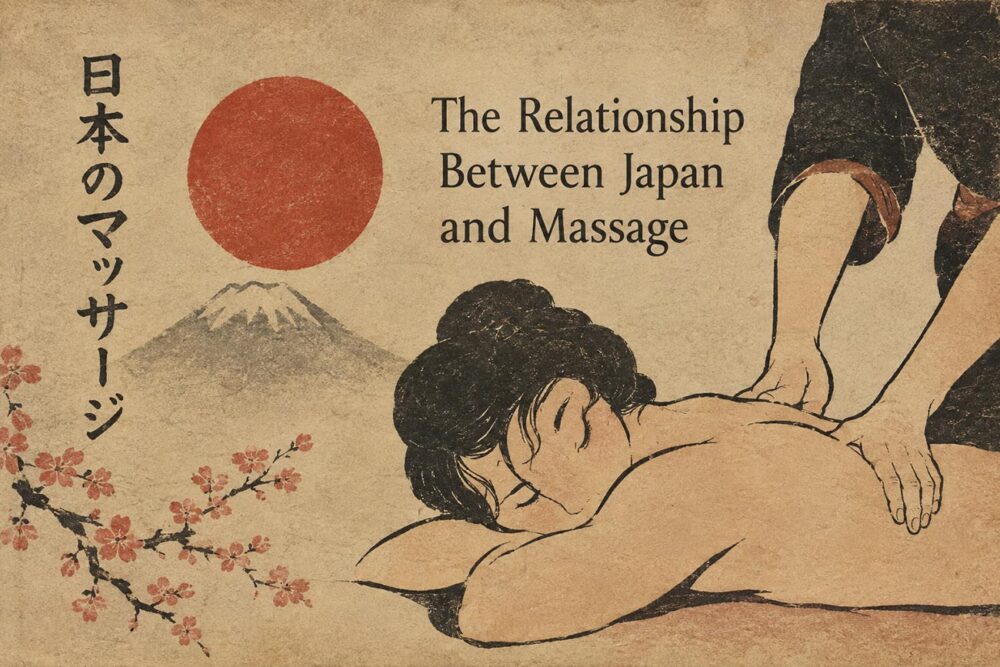
In English, it is generally referred to as Japanese massage or Japanese bodywork, while in Japan some of its best-known traditional forms are called Anma (あん摩) and Shiatsu (指圧). In Spanish, the practice is commonly described as masaje japonés or masajes sensuales orientales. Few cultures have developed such a sophisticated relationship with the body as Japan. From the quiet, focused pressure of shiatsu to the rhythmic techniques of anma, Japanese bodywork has traditionally understood touch as more than simple physical manipulation. Massage can become a way of restoring balance, calming the mind, cultivating awareness, and reconnecting with one’s own body.
For modern audiences, this tradition has also become associated with ideas of sensuality, energy and spiritual intimacy. That connection deserves some historical clarification. Japan does have important esoteric Buddhist traditions with concepts involving the body, consciousness, ritual and transformation. However, what is commonly called “tantric massage” today should not simply be presented as an ancient Japanese practice. Tantra originated primarily in South Asian Hindu and Buddhist traditions and later spread across Asia, including Japan.
The fascinating story, therefore, is not that Japan invented tantric massage. It is how Japanese ideas about touch, discipline, bodily awareness and spiritual practice can intersect with the modern understanding of Tantra.
Anma: The Older Japanese Tradition of Touch
The history of Japanese massage begins long before the contemporary popularity of shiatsu.
Anma (あん摩) developed from older Chinese medical traditions that entered Japan through the Korean Peninsula around the sixth century. One of the important antecedents was a form of manual therapy known as ankyo, which was associated with the meridian-based understanding of traditional Chinese medicine. In Japan, these practices were gradually adapted to local preferences and eventually developed into the Japanese anma tradition.
Even the word anma reflects the physical nature of the discipline. It combines concepts associated with applying pressure and stroking. Traditional anma uses kneading, pressing and rhythmic movements, generally across the body and often through clothing. Modern Japanese anma, however, is not simply a system of manipulating invisible energy. Contemporary descriptions emphasize anatomy and muscles alongside traditional concepts.
This distinction is important because modern Western descriptions of Japanese massage sometimes turn every Japanese bodywork practice into a mystical system. The historical reality is more interesting: Japanese massage has always occupied a space where physical technique, health, relaxation and traditional East Asian theories of the body overlap.
Shiatsu and the Language of Pressure
Perhaps the best-known Japanese bodywork tradition outside Japan is shiatsu (指圧).
The name literally refers to finger pressure, and the technique developed in its modern form during the twentieth century. Tokujiro Namikoshi is credited with establishing shiatsu under that name in 1925, later creating a school dedicated to teaching the method. Shiatsu subsequently became formally recognized within Japan’s professional framework for massage and related practices.
Shiatsu is fascinating from a body-spiritual perspective because it emphasizes something very simple: attention through touch.
The practitioner does not necessarily need dramatic movements. Pressure can be sustained, rhythmic and deliberate. The recipient is encouraged to notice sensations rather than simply waiting for the practitioner to “fix” something.
That creates an experience very different from the idea of massage as a purely mechanical treatment.
The body becomes something to listen to.
Pressure becomes communication.
Breathing becomes part of the experience.
And stillness becomes just as important as movement.
This is one reason Japanese bodywork can feel particularly compatible with contemporary ideas of mindfulness. The connection is not necessarily that traditional shiatsu was designed as a meditation technique, but that both practices can encourage sustained attention to immediate bodily sensations.
The Japanese Idea of the Body
Traditional Japanese culture contains many practices that place importance on disciplined bodily awareness.
Tea ceremony, martial arts, meditation, calligraphy and various forms of traditional craft all share an interesting characteristic: repetition is not necessarily considered boring. Repetition can develop sensitivity.
The same principle can be applied to bodywork.
A skilled practitioner does not simply apply force. They learn to recognize differences in tension, resistance, temperature, breathing and muscular response. The body communicates through subtle changes.
This is particularly relevant to the spiritual dimension of massage.
Rather than separating “mind” and “body,” many Asian philosophical traditions have historically treated bodily experience as part of a larger process of cultivating awareness. Japanese Buddhist traditions, including esoteric forms of Buddhism, inherited and developed practices involving visualization, mantra, ritual and the transformation of ordinary experience. Tantric Buddhist traditions themselves spread from India into China, Korea and eventually Japan, where they became associated with Japanese esoteric Buddhism such as Shingon.
That historical connection is real—but it is different from saying that Japanese shiatsu is a form of Tantra.
Tantra and Japan: A More Complicated Relationship
The word Tantra is frequently associated in modern popular culture with sexuality, intimacy and sensual massage. Historically, however, Tantra is considerably broader.
Tantric traditions emerged in South Asia and developed within both Hindu and Buddhist contexts. They incorporated practices involving mantras, visualization, ritual, meditation and theories of the body and consciousness. Some traditions included sexual symbolism or ritual, but reducing Tantra to sexuality misses much of its religious and philosophical history.
Tantric Buddhism eventually traveled beyond India. In Japan, esoteric Buddhist traditions developed through the transmission of Buddhist teachings from the Asian mainland. Japanese Shingon Buddhism, associated particularly with Kūkai, represents one of the most important Japanese expressions of this esoteric Buddhist heritage.
This gives Japan a genuine connection to the wider tantric world—but not necessarily through massage.
The modern concept of “tantric massage” is better understood as a contemporary practice that draws inspiration from several traditions and combines ideas about sensuality, meditation, breath, presence and embodied awareness.
Where Massage Becomes Sensual
Massage has always had an intimate quality.
Allowing another person to touch the body requires trust. The recipient becomes attentive to sensations that are normally ignored during everyday life: the rhythm of breathing, muscular tension, warmth, pressure and relaxation.
This intimacy can become sensual without necessarily becoming explicitly sexual.
That distinction is especially relevant to the philosophy behind many modern tantric and holistic massage practices. The objective can be to slow down the experience of touch and make sensation itself the focus.
Instead of asking, “What happens next?” the attention remains on what is happening now.
The hands move slowly.
Breathing becomes deeper.
The recipient becomes aware of the body.
The boundary between physical relaxation and emotional release can become less rigid.
In this sense, massage can function almost like a form of embodied meditation.
Japanese aesthetics can make this idea particularly compelling because Japanese traditions often place value on simplicity, rhythm and controlled movement. The experience does not necessarily require spectacle. A quiet room, deliberate touch and awareness of breathing can be enough to transform the atmosphere.
The Spiritual Side of Japanese Bodywork
It is tempting to describe Japanese massage using words such as energy, chi, meridians or spiritual balance. These concepts do appear in traditional East Asian medical frameworks, but they should not automatically be treated as scientifically established mechanisms.
There is, however, a legitimate psychological and experiential dimension to bodywork.
Research into anma, for example, has examined effects on subjective symptoms and anxiety. A small preliminary study reported reductions in subjective symptoms and state anxiety following anma sessions, while another study observed changes including reduced muscle stiffness and anxiety after a full-body session. These studies are limited and should not be interpreted as proof of every traditional claim, but they illustrate why Japanese massage continues to attract interest beyond simple physical relaxation.
The spiritual interpretation can therefore be approached as an experience rather than a medical claim.
Massage encourages a person to inhabit their body.
It can interrupt the constant mental activity of daily life.
It can create a period in which attention is directed inward rather than toward screens, work or external demands.
And for some people, that sense of returning to the body is precisely what makes the experience feel spiritual.
From Traditional Practice to Modern Sensual Wellness
The modern wellness industry has increasingly combined Japanese, Indian, Chinese and Western approaches to bodywork.
As these traditions travel between cultures, their boundaries become less rigid. Shiatsu may be practiced alongside meditation. Yoga studios may offer Japanese-inspired bodywork. Western massage therapists may incorporate breathing exercises or concepts associated with Tantra.
This cultural exchange can be valuable, but it also creates the possibility of historical confusion.
Calling a contemporary sensual massage technique “ancient Japanese Tantra” may sound attractive, but it does not accurately describe the history.
A more interesting approach is to acknowledge the different traditions and then explore what they have in common.
All of them, in different ways, can ask a similar question:
What happens when we stop treating the body as something separate from consciousness?
That question provides a natural bridge between Japanese bodywork and modern tantric practices.
The Body as a Path to Presence
Perhaps the strongest connection between Japanese massage and the spiritual body is not a particular technique.
It is presence.
Japanese massage traditions developed sophisticated approaches to pressure, rhythm and bodily sensation. Japanese esoteric Buddhism developed practices involving body, ritual, visualization and consciousness. Modern Tantra has adopted and transformed ideas about intimacy, breath and embodied awareness.
They are not the same tradition.
But they can meet in the experience of paying close attention to the body.
In a world increasingly dominated by digital interaction, constant stimulation and mental multitasking, slow physical attention can feel almost revolutionary.
A massage asks us to stop.
To breathe.
To feel.
To notice.
And perhaps most importantly, to become present inside the body rather than simply thinking about it.
That is where the relationship between Japan and massage becomes particularly fascinating. The deepest lesson is not necessarily about pressure points, techniques or exotic terminology. It is about the possibility that touch can become a form of communication—and that conscious attention to the body can become its own kind of contemplative practice.
From anma to shiatsu, and from Japanese Buddhist traditions to the modern global language of Tantra, the history is complex. But the enduring attraction is remarkably simple: the human desire to reconnect with the body, slow down the mind and experience touch with greater awareness.